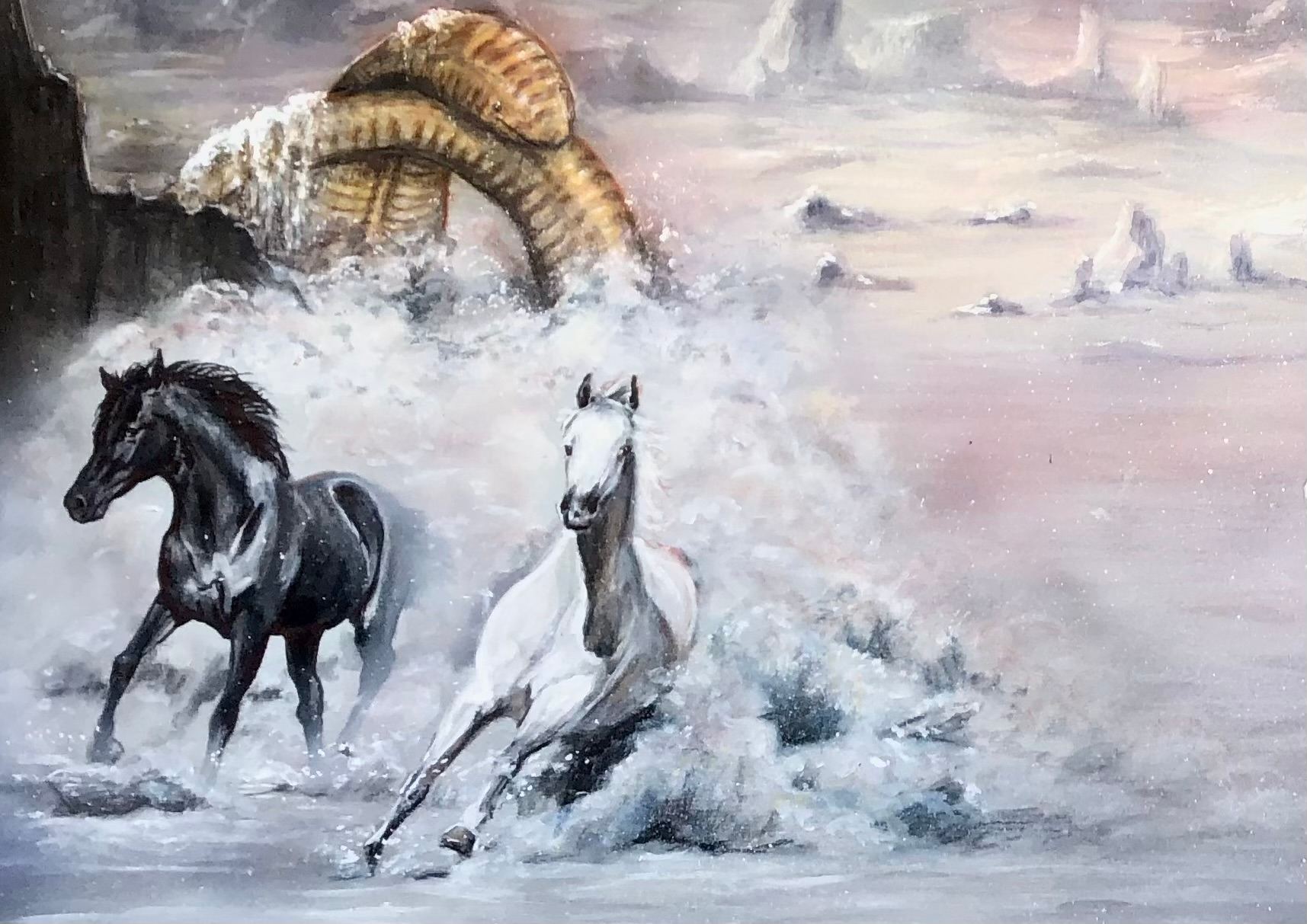
Camis, run! Do not use mindspeak—just run!
And he does instinctively, plunging into the darkness, leaving the cart and fleeing. The long grass and shrubs soak him more than the light rain. His hair whips out behind him, and his hood is thrown back, useless.
Unseen branches claw, grasp, grab. Feeling his cloak snag and hearing fibres rip, he races on. Ruts and holes try to snare him; tufts and mounds catch his feet, causing him to stumble and trip, but he staggers on, fear nipping at his heels. With his breath rasping and his heart pounding, he runs.
Trees loom on either side of him, black pillars in the night, causing him to slow and then to stop. Clutching his side, he listens between great gulps of air.
Nothing.
Sinking down, he crouches warily in the deep leaf litter, waiting for her to call him back.
His pulse races. So much to fear. She’d made sure of that. She’d made certain from an early age Camis had understood the importance of avoiding strangers, especially those not attached to a homestead, village or farm.
He remembers the pains she took to hide him and their cart—if she had enough time—and the way she pulled up her hood to hide her face and hair. Or the way she’d made him sit up on the cart if people approached, telling him not to speak under any circumstances.
When he was a toddler, she had grabbed his arm, pulling him back as two men walked into their camp. They were hunters and had only wanted some help as one of their group had had an accident.
Go back and wait by the cart, she had hissed into his mind. Wait there and don’t move.
He rubs at his arm unconsciously where she had grasped it all those years ago. An owl hunting over the grass plains hoots, bringing him back to the present. Apart from the soft sound of rain, the night is silent.
Camis awakes with a sharp intake of breath and casts about, trying to make sense of where he is. It is still night, and he can see nothing, only the pallid shapes of silver birch blending with the darker trunks. He has no idea how long he has waited because the trees and clouds hide the moon. It may only have been moments, or it could have been hours.
Gradually, his heartbeat slows, but his shoulders remain rigid. He tunes his senses to the night, hearing the breeze sighing through the treetops, the dull plash of rain hitting the woodland floor and the leaves rustling beneath him. Beyond lie the snuffling, scuttle and scrape of the nocturnal world, carrying on in its natural rhythm. He listens hard, harder than he has ever listened before.
Why hasn’t she called to him?
An owl screeches as it hunts, and a pair of foxes jabber to each other in the distance. Nothing to alarm him. The air is full of the musty mould of bark and leaf litter, all comforting and normal. Breathing it in, tasting decay, his stomach rumbles.
Who or what have they been running from all this time? He vows to make her tell him, once they are safely back together. Yes, this time, he’ll make her tell him.
Wriggling, he settles more comfortably against the tree, finding a spot where the ridges stab his back a little less.
He practises the long, slow breaths of relaxation that he has been taught. Picturing a flame burning atop a candle, waiting for the breathing exercises to work their magic—to smooth the worry from his brow; to still the tiny teeth gnawing at his gut. But the flame flutters and wavers; he can’t relax.
It has been too long. She will call him. She will.
Fear helps him to fight sleep for a while, but soon he drops back into a fitful doze.
The birds wake him, and the damp of dawn seeps through his britches. Rising, Camis stretches, then rolls his shoulders back, trying to work the knots out, feeling the bruises beneath his clothes and the scrapes on his hands.
He breathes in deeply, then swallows, his mouth dry, wishing he had some water. Blinking the night from his eyes, he strains to see into the predawn dark. Carefully retracing his path, he feels his way from tree to tree, walking quietly and stopping often to check for any sound that will warn him that danger is still there.
He doesn’t know what they are running from. This makes the knot in his stomach tighten. Irritated, he hugs his damp cloak tighter. He is old enough now, and he will refuse to run anymore unless she gives him answers.
The walk to the edge of the woodland seems to take forever, and it is fully light when he at last looks out over the plains. Rubbing his hands, he wonders again why she hasn’t sent word. Where is she?
He stares at the distant shape of their old horse cropping the grass, unconcerned.
What did you see, old girl? Do you know what happened to her?
He looks at the wider landscape and sees a cluster of trees in full leaf on a distant hill, surrounded by green bushes. The yellow-grass plains stretch in all directions. Birds twitter and sing in the wood behind him. Others fly, swooping low across the abundant vegetation, catching insects as they rise, warmed by the sun. He can even see rabbits feeding, their white tails bobbing, and he thinks of his snares in the cart. Everything is normal, full of late-summer life and the smell of the ripening fruits of autumn. Normal—except that she is not here.
Every instinct screams at him to use mindspeak, but he resists. ‘Beware of using mindspeak, Camis,’ she had always said. ‘You never know who is listening.’ So, he waits.
Tension returns to his shoulders. His stomach growls, and he feels a little lightheaded, but he remains in the shadows of the trees until the sun is high in the sky. Still nothing.
It is the sight of two thief birds alighting on the side of the cart that galvanises him into action. One of them hops over to sit on top of a sack, flicking its long, black tail and eyeing it in that sideways intensity that birds have.
Pig’s feet!
Stiffly, he leaves his hiding place, waving his fists and shouting. The movement alarms the birds, and they rise in a flurry of black and white to curve around him, flying back to the woodland.
Warily, he approaches the cart. Something tickles his nose—a vague, distant smell. It reminds him of a blacksmith’s forge, full of heat and steam. He breathes in slowly and deeply, trying to place the smell, but it slides away like a fish in water.
The horse wickers softly in recognition as he approaches. She comes to him, gently muzzling in his pockets. He pushes the soft, whiskery lips away, feeling angry.
‘Not now, Misty. I’ll feed you soon.’
Maybe he should have waited for her longer. But what if she were hurt? What if she was waiting for the right time to contact him? How is he supposed to know? Why couldn’t she just have explained things to him before now?
Everything at the site is how they left it. Nothing wrong, nothing broken, nothing missing—except her.
Their bedding tumbles out from under the cart, abandoned in the urgency of the night. Checking the ground around the camp, he finds nothing. No footprints other than his own. No scuff marks, not a blade of grass out of place. Where has she gone? How had she known someone was approaching?
For a long time, he stands transfixed, biting down again on his lower lip until the skin feels tender under his teeth. He feels small, useless. What if . . . what if she doesn’t return? But she even had that eventuality covered.
‘Go to the farm. Go on without me,’ she had said.
He shakes his head. Unthinkable.
He rummages in a half-open sack, feeling the flat, flowery scales of oat, and scoops out three big handfuls.
‘There you go, Misty. Better late than never.’ He combs his fingers through the coarse fringe between the horse’s ears. When she has finished eating, she flicks the bucket playfully up and out of his hands.
‘So, I’m forgiven, eh?’ He smiles, forgetting his situation for a moment.
Sitting on the back of the cart, he breaks apart a small, brown loaf and eats, washing the dry bread down with gulps of water from his flask. Still waiting for her to call to him, waiting for her signal. Waiting.
He bites down hard on his lower lip again, a habit she has tried to get him to break.
‘Camis!’ he can hear her remonstrate. ‘Don’t do that. You are leaving a mark.’ She had brushed her fingers gently along his lip. He had felt the familiar tingle of her healing.
He remembers their last stop, two days ago, when his mother was bending over the baby with croup, a strand of her hair falling forward, vivid in its autumn glow, her touch tender and loving as she laid her palm gently on the baby’s chest.
He had watched while she dripped a weak herbal remedy on the child’s lips, while the family held their breath. The baby’s tongue had flicked in and out, and the crying had abruptly stopped.
The family had hugged his mother, thanking her over and over. The baby fed lustily while Camis’ mother relaxed with the villagers and caught up with their gossip.
Camis had stood awkwardly alongside the adults, looking at a group near his age who sat in the long grass on the outskirts of the village, laughing and joking. For fifteen summers, he had never had anyone his own age to be with.
A buzzard mewls overhead and then hovers high in the blue sky. A yellow light flickers a little way above the horizon, catching his eye. It pulses, then vanishes. He waits. Is it a message from her? He watches for it again, but it does not reappear.
Jumping down from the cart, he scours the ground in more detail. He finds his own footprints smudged and blurred from the rain, but they lead away as he expected. There are no others.
He looks up across the grass plains to the shrubland and towards the stand of trees in which he’d sheltered for the night. He checks the area again for signs of a scuffle. But there is nothing. He forces down his rising panic.
Just wait, he tells himself. She trained you enough times for this. Wait and stay calm.
The next morning, it is hard to rouse himself. He doesn’t know what to do. His clothes have dried on him, and now the sweat and dirt are irritating his skin, making him scratch. He should get up and wash—and feed Misty, but he doesn’t want to move. His arms feel heavy. Even thinking is an effort.
It suddenly comes to him like a sharp slap—move. Keep to the plan. Head for their winter home. Anna and Luk will be waiting. Stock up on herbs and supplies on the way. She will know to look for him there. She will find him at Homefarm.
‘Pig’s feet!’ he says out loud and sits up.
Misty stops eating, shakes her head free of the flies and looks at him. He shivers and sighs before he looks back the way they had come, squinting into the rising sun. Then he peers, for the hundredth time, towards the distant shimmer of silver. The river. Head that way.
‘Come on, Misty. Time to go.’
He packs up his bedding, ignoring the hollow in his stomach, and hitches Misty to the cart, then climbs up and clicks her into a walk. In the late afternoon, Camis stops on the riverbank by a copse of willows whose branches trail low into the slow-moving water and makes camp. First, a wash.
In the river, he lathers up his hair, rubbing in some soaproot and dunking his head into the clear water. The flow around him runs briefly with bubbles and dirt. His hair sticks to his face and neck, the sandy colour darkening to gold. He sweeps his hair back, squeezing it tight. Better let it dry before tying it back in a tail.
Misty watches him as he swims and splashes. A frown wrinkles her old head as she trots up and down the riverbank, keeping pace with him as he floats on his back. He lets the slow current bob him along, recalling the reason why the old horse is so agitated.
His mother had told him of how he had nearly drowned before he was even born. Heavily pregnant, she had been crossing a river when the current suddenly caught her, whisking her off her feet. It was Misty who had rescued her. Pushing out to swim alongside her, the mare had waited until his mother had tangled her hands into the horse’s rough mane, then she had hauled them both safely to the shore.
His mother had paused then and he had glimpsed a dark shadow cross her face.
‘Once we had landed, that’s when you decided to show your face.’ Then she had laughed, her eyes lighting up and crinkling at the corners.
Later—years later—he’d asked her why she had tried to cross the river.
‘I was being chased. Luckily, the river dragged us far downstream.’ But that was all she would ever say. Why had she been fleeing? Who was she running from? He wondered if her past had finally caught up with her.
Misty doesn’t rest until Camis is back on dry land. Then she trots away, tail flicking, snorting as if tutting, and puts her head down to the grass and ignores him.
Once dry and dressed, he locates a large wooden chest on the cart. He pulls a leather thong from around his neck and fits the key that hangs from it into the lock.
Carefully, he rifles through the pottery phials and removes the stopper from one. He gives it a cautious sniff. The bitter blast of thunderdog vine shoots up his nose. Gagging, he rapidly replaces the top. He holds the small bottle up and shakes it. He can’t use all of it as he doesn’t know when there will be more. He will have to make do with willow bark for now.
He selects a slightly larger container and pours out a thumbnail drop of aromatic oil and massages it into his hands that still ache from his first healing a few days before.
Collecting wood on his way back to camp, he scouts the area, looking for good places for snares. There is evidence of rabbits further along the bank, amongst an old thicket of bramble.
After another cold meal, he retires early. Lying awake under the cart for a long time, he feels the familiar irritation that has plagued him all his life. Who or what are they running from? Why does she never explain further than “Run, Camis, run”? And where in Maa Erda’s name is she? The questions swirl and repeat. He clamps his teeth shut, stopping the tingle in his nose and the threat of tears. Nearly fifteen, he tells himself. He’s too old for that.
Perhaps he’d better stick to the plan. He sighs and snuggles under his blanket, resolving to leave in the morning for Homefarm.
The next morning, he squats over his snare, loosening the wire from around the rabbit’s neck. As he picks the limp body up, his mind flashes back to a few days ago when his gift had first made an appearance.
He’d been checking his snares and had found a freshly caught rabbit. But it had been caught by its foot and was still alive. The creature had frozen in fear as he’d handled it, but instead of a quick twist and pull on its neck to dispatch it, something had made him hesitate.
He’d looked at the broken skin around its leg and felt pity. He had laid his fingers over the injury, feeling the broken bones beneath grate and grind. An intense heat had flared through his hand down to the rabbit. He could feel the bones knit and heal and see it all in his mind’s eye.
Though it had only been an instant, when he removed his hand, the wound on the rabbit had closed. In surprise, he had dropped the rabbit and it had zigzagged away into the undergrowth, leaving him gaping after the white flash of its tail.
‘About time!’ his mother had said when he returned to their camp to tell her. The smile she’d given him had lit up the day—her green eyes had sparkled. ‘Been waiting a long time for this, Camis. I was hoping you would have The Gift too. Now your training starts in earnest!’
And she had laughed at his face, saying, ‘Be careful, the wind might change.’
The next day, he checks their herb supply. He opens all the bags on the cart and checks their contents. Carefully, he reseals them. He will have to restock quite a few of them on his way to their winter home.
Scanning the grassland, he walks away from the river out into the rich green pasture. Absorbed in carefully cutting stems from wild dwarf rosemary, useful for its disinfectant qualities, he nearly misses the first warning. He feels a faint thrumming vibration beneath his feet.
Standing up, he looks around and then he sees them—riders, racing across the wide plains. Riders coming fast and coming towards him!
He sprints towards the river, legs pumping, gripping his herb bag, racing towards camp.
As he hurtles towards Misty, the thumping of his heart grows louder, mingling with the beat of hooves. He runs with eyes wide, muscles straining. Running again in fear for his life.
In mid-leap, he hears a crack.
Blackness.